

A hashtag that began trending on Ghanaian social media in late May 2026 is now shaping the political environment in which Gold Fields, the Johannesburg Stock Exchange-listed gold major, must secure a 20-year renewal of the Tarkwa mine lease — an asset that generated revenue of $2.3-billion, or approximately R37.8-billion at current exchange rates, in 2025 alone.
The five Tarkwa mining leases expire in April 2027. Gold Fields submitted its renewal application in November 2025. As of June 2026, no final decision has been issued. What has changed materially in the intervening months is not the technical case for renewal — it is the political permission environment in which that renewal must be granted.
The Damang precedent
The significance of the Tarkwa situation cannot be understood without first examining what Ghana did at Damang. In April 2025, the Government of Ghana declined to renew Gold Fields’ operating licence for the Damang gold mine. Rather than negotiate revised terms, the government conducted a restricted tender open exclusively to Ghanaian-owned firms. The winning bid was awarded to Engineers and Planners Co Ltd, a locally owned firm with prior service contract experience at both the Damang and Tarkwa operations.
The Damang outcome is not a threat or a negotiating posture. It is a completed administrative process that demonstrates Ghana possesses both the policy will and the institutional capability to execute a full operational transfer of a major gold mine. Prior to Damang, the restricted-tender model was theoretical. It is no longer.
Ghana’s Minerals Commission CEO Isaac Andrews Tandohconfirmed in late May 2026 that the Tarkwa renewal review remains formally active. “It won’t be business as usual where we just automatically renew the lease,” Tandoh told Reuters. The company must present its development plans to a technical committee at the Minerals Commission, followed by a ministerial-level review. Only then will a final decision be made.
Tandoh also set out a new three-pillar standard: demonstrated local value creation, technology transfer to Ghanaian operators, and verifiable community development commitments. None of these were formal requirements under the previous licensing framework.
The hashtag that reached the lease negotiation
The political context shifted sharply in April and May 2026. Demonstrations organised under the “March and March” movement in Pretoria, Johannesburg, and Durban targeted foreign nationals in South Africa, including Ghanaian shopkeepers and traders. In Estcourt, a mayor was reported to have seized the keys to Ghanaian-owned businesses and handed them to local operators.
On May 27, 2026, the Government of Ghana airlifted the first wave of 300 citizens out of South Africa. Ghana’s High Commissioner to South Africa Benjamin Quashie confirmed that 826 citizens had registered to return home. The government issued a formal warning to nationals still in the country to close their businesses and remain indoors.
The images of exhausted and distressed returnees arriving at Accra airport did not remain on the news. They moved immediately onto Ghanaian social media — and collided with a pre-existing public debate about who should benefit from Ghana’s natural resources.
Within 48 hours, the hashtag #DontRenewGoldfieldsLeasewas trending across X, Facebook, and WhatsApp in Ghana. The campaign was not anonymous. It carried named voices from across Ghanaian civil society and political life.
Eric Adjei, Chief Executive Officer of the National Entrepreneurship and Innovation Programme (NEIP), posted on X on May 27, 2026, tagging Lands and Natural Resources Minister Emmanuel Armah-Kofi Buah directly. “To Ghanaians coming home because of the xenophobic racism, we love you all. But to the Minister for Lands and Natural Resources: please do not renew the mining lease for Gold Fields Tarkwa,” Adjei wrote. On June 3, 2026, Adjei went further, calling on the government to take operational control of Gold Fields entirely.
Kofi Bentil, Vice President of the IMANI Africa policy think-tank, stated publicly: “We will do everything we can to ensure your lease is not renewed because people in your country are hostile to our people.” Franklin Cudjoe, IMANI’s Founding President, also entered the debate, calling for Ghanaian investors to mobilise around ownership of the mine.
Civil society organisation Arise Ghana issued a formal statement calling on the government to transfer the Tarkwaconcession to local firms, specifically naming Engineers and Planners — the Damang recipient — as the preferred operator. The Member of Parliament for Mpraeso, Davis Ansah Opoku, called in a public Facebook post on May 9 for the lease extension to be tied directly to concrete action by Pretoria to address the violence against foreign nationals.
Gold Fields responds; presidential diplomacy invoked
Gold Fields CEO Mike Fraser has stated publicly that the company remains committed to the Tarkwa renewal. “We are not going to give up in any way on Tarkwa. In November last year, we submitted a lease extension for the Tarkwa mine, which would give us another 20 years of mining at Tarkwa,” Fraser was quoted as saying by the Daily Graphic. The statement, widely reported in Ghanaian media, appears to have intensified rather than softened the public campaign against renewal.
Gold Fields’ Q1 2026 operational update listed progressing the renewal of the Tarkwa mining lease as a priority area, alongside the Damang transition. The company has also outlined its “Tarkwa 2030” vision, which focuses on decarbonisation and increased automation to extend the mine’s life.
Tarkwa produced approximately 427 000 oz of gold in 2025. At current gold prices — which have traded above $4 700/ozin mid-2026 — the difference in fiscal terms between a renewed lease under historical royalty terms and a renegotiated arrangement with significantly higher state participation is material. The Ghana Chamber of Mines warned in May 2026 that renewal uncertainty “could create a perception that security of tenure in Ghana is not guaranteed,” a signal of how seriously the broader investment community is treating the situation.
According to reporting by NOWinSA in late May 2026, Gold Fields executives are now reportedly calling on President Cyril Ramaphosa to personally lobby Ghanaian President John Dramani Mahama. The lease renewal has escalated from a regulatory review to a matter of presidential diplomacy between two sovereign nations.
The broader continental exposure for South African companies
The Tarkwa situation sits within a larger pattern of South African corporate exposure across the African continent that the narrative out of South Africa has brought into sharp relief. MTN Group, whose Ghana operations have contributed materially to subscriber growth at a time when South African domestic growth has slowed, dispatched a senior executive to meet Ghanaian officials and announced support for repatriated nationals. Nigerian student unions threatened organiseddemonstrations outside South African companies’ Nigerian offices. The US Trade Representative launched a Section 301(b) investigation into South Africa in March 2026, partly linked to a trafficking-related regulatory downgrade.
South African companies operating across Africa have long benefited from the relative stability and institutional depth of their home base. The reputational risk that is now flowing in the opposite direction — from South Africa’s domestic politics into the operating environments of its most significant outbound investors — represents a structural shift that the mining sector’s IR and comms functions are only beginning to grapple with.
Does reputation play a larger role in licence decisions than the industry admits?
The mining industry’s standard framework for licencerenewal is built on operational metrics: production output, royalty compliance, environmental performance, capital investment commitments. The Tarkwa case raises a different question: whether political permission structures in Africa are now built on a wider foundation than technical compliance.
Gold Fields can demonstrate 427 000 oz of annual production, royalty payment history, and a credible 20-year investment plan. It cannot control the political context in which those credentials are being evaluated — a context now shaped in part by how South Africa’s domestic anti-immigration politics are being read in Accra.
From the emergence of the narrative in South Africa in April 2026 to the formal escalation of the Tarkwa renewal dispute to presidential-diplomacy level took approximately four weeks. In that window, a campaign hashtag went from non-existent to trending, named government officials made public statements on social media, a parliamentary MP formally tied the licence decision to a bilateral diplomatic condition, and the commercial exposure of an asset generating R37.8-billion in annual revenue shifted materially — most of it in the open, on platforms that are free to access, in real time.
The question for South African mining companies operating beyond their borders is not whether social media sentiment influences regulatory decisions. The Tarkwa case makes clear that it does. The question is whether those companies have the monitoring capability to know what is being said about them — across borders, in languages other than English, on platforms that their Johannesburg communications teams may not routinely track — before it reaches the boardroom in the form of a presidential phone call.
Will the hashtag cost Gold Fields its seat in Ghana?
The lease does not expire until April 2027. Gold Fields has time — but the environment in which it must negotiate has changed in ways that an operational update or a technical compliance presentation may not be sufficient to address.
Ghana has already demonstrated it can and will transfer a major gold mine to local operators. The Damang precedent is not a threat. It is a completed fact. The Tarkwa decision will be made by a government navigating significant domestic political pressure, at an elevated gold price that strengthens the fiscal case for demanding more from any operator, regardless of origin.
The narrative out of South Africa did not create Ghana’s resource nationalism posture. But it handed that posture political momentum that might otherwise have taken years to accumulate. And it exposed something the mining sector has been slow to internalise: that the reputational licence to operate now travels across borders as fast as a social media post — and that most of the monitoring systems designed to protect it were not built for that speed.
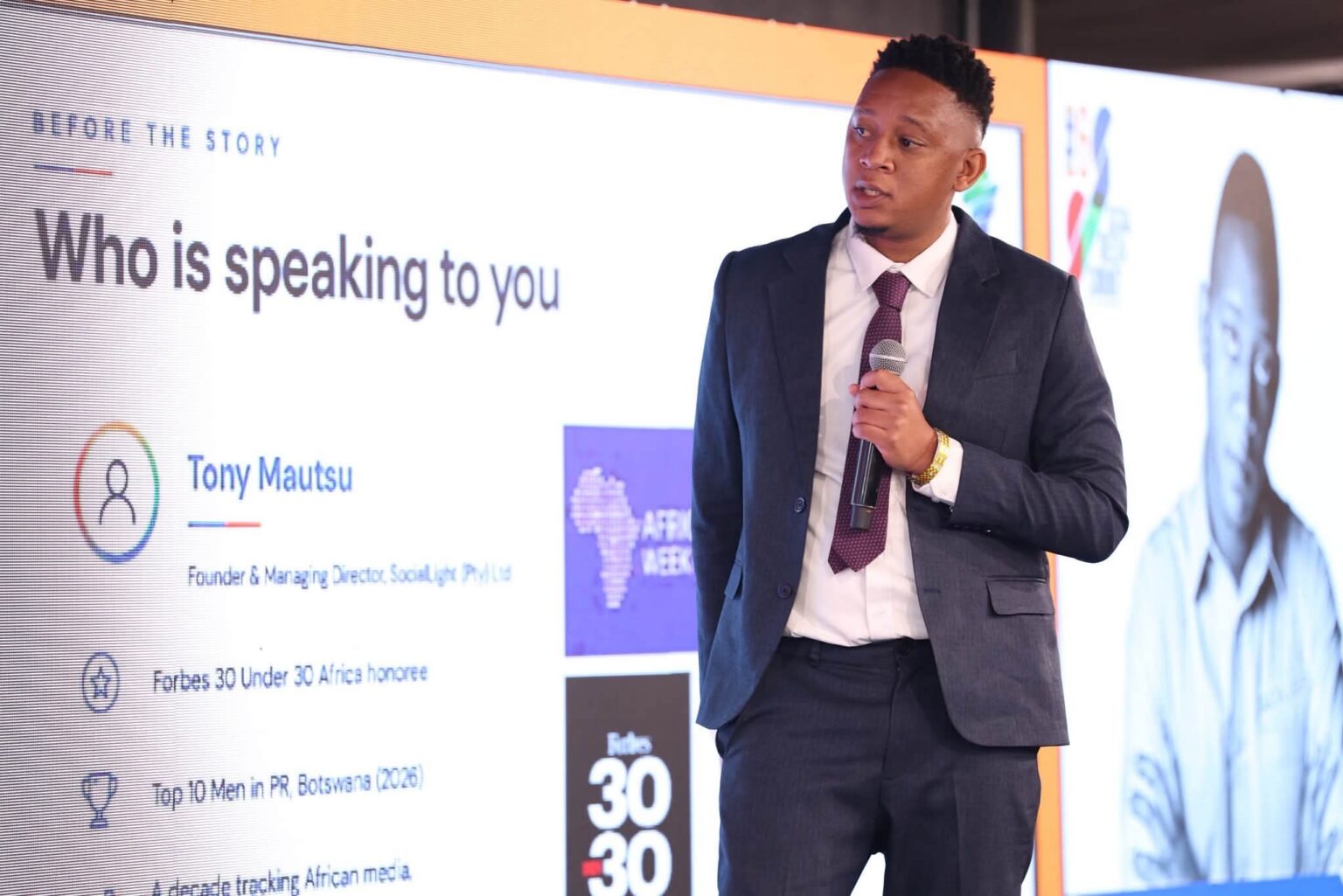
By Tony Mautsu, Founder and Managing Director of SocialLight.africa, an Intelligence-as-a-Service platform tracking media sentiment, social narrative, and reputational risk across the SADC region. SocialLight.africa is headquartered in Gaborone, Botswana, with operations in Johannesburg, South Africa.